Threat Intelligence •Sep 13, 20
Create actionable intelligence from suspicious files, hashes, IP addresses, domains, URLs, vulnerabilities, and other security indications.
The goal of ThreatFusionAI, an AI-powered cyber threat intelligence platform, is to speed up threat investigations for SOC teams, security analysts, threat hunters, researchers, and incident responders. You can find an indicator's reputation, malware behavior, associated infrastructure, threat relationships, MITRE ATT&CK activity, and potential threat actor connections by pasting it into a single search form.
Use a single threat intel platform to determine what an indicator is, if it is malicious, what it connects to, and where your investigation should move next rather than examining several security tools separately.
Threat intelligence turns unprocessed security data into knowledge that your security team can look into and take action on.
An odd IP address could be included in a firewall alert. A suspicious file hash could be included in an EDR alert. A fraudulent URL or domain may be the first step in a phishing inquiry.
These values don't offer much context on their own. When they are linked to malware samples, infrastructure, vulnerabilities, campaigns, attacker behavior, and other indicators of compromise in cyber security, their true worth becomes apparent.
By combining these solutions, ThreatFusionAI allows analysts to spend more time looking at threats and less time gathering data.
Every Cyber Attack leaves traces.
A malicious attachment has a file hash. Malware communicates with an IP address. That IP may host multiple domains. A malicious domain can distribute additional payloads. Exploitation may target a known CVE.
These traces become useful when they are correlated.
These are often called atomic indicators of compromise because they represent individual observable values that security tools can search, detect, block, or correlate.
Security teams do not suffer from a lack of security data. They suffer from too much disconnected data.
ThreatFusionAI uses automation and AI to correlate indicators, malware behavior, infrastructure relationships, threat actors, campaigns, and MITRE ATT&CK activity.
A single malware sample can communicate with multiple domains and IP addresses. Those indicators may already be connected with hundreds of other samples.
To enable analysts to transition from one indicator to the larger attack infrastructure, ThreatFusionAI automatically maps these relationships.
Not every indicator has the same investigative value.
The platform brings together reputation information, malware behavior, relationships, threat context, and attacker techniques to help analysts identify which findings deserve attention first.
An integrated AI assistant helps analysts understand investigation results in simplified language. Ask about malware behaviour, IOC relationships, threat actor attribution, MITRE ATT&CK techniques, investigation findings or how to interpret a report.
Where automation stops. Automation narrows the investigation. Analysts retain responsibility for the final judgment. We rank, score and connect.
An IOC lookup is often the fastest way to begin a security investigation. Paste the indicator you already have and allow ThreatFusionAI to connect it with available intelligence.
Seven supported indicator types, one search box. Available intelligence depends on the indicator type.
Domain and URL intelligence also serves as a Malicious Website Checker, supporting phishing, malware and suspicious-link investigations. Analyse a suspicious URL or domain before determining whether to block, escalate or investigate further. Results should be treated as security intelligence for the investigation rather than a substitute for organisational security controls.
Malware Analysis Without Switching Between Multiple Tools
ThreatFusionAI consolidates the investigation data that traditionally requires multiple tools: antivirus engines, sandbox environments, reputation databases, IOC extraction tools, threat intelligence feeds and manual research. More than 1.8 million samples have already been processed.
Start with a file hash, IP address, domain, URL, or CVE found in an alert, SIEM event, EDR detection, phishing investigation, or malware report.
ThreatFusionAI correlates available information from malware analysis, reputation intelligence, sandbox telemetry, antivirus results, OSINT sources, and existing platform relationships.
Malware rarely operates alone. A file may connect to an IP. That IP may resolve to several domains. Those domains may appear in other malware samples. ThreatFusionAI connects these relationships automatically.
Pivot between connected indicators and expand the investigation until you understand the wider threat.
Instead of treating different malware analysis tools as isolated sources, ThreatFusionAI focuses on correlation. Security analysts can investigate:
This moves an investigation from the basic question — is this file malicious? — to the comprehensive one: what infrastructure, behaviour, malware and threat activity connects to this file?
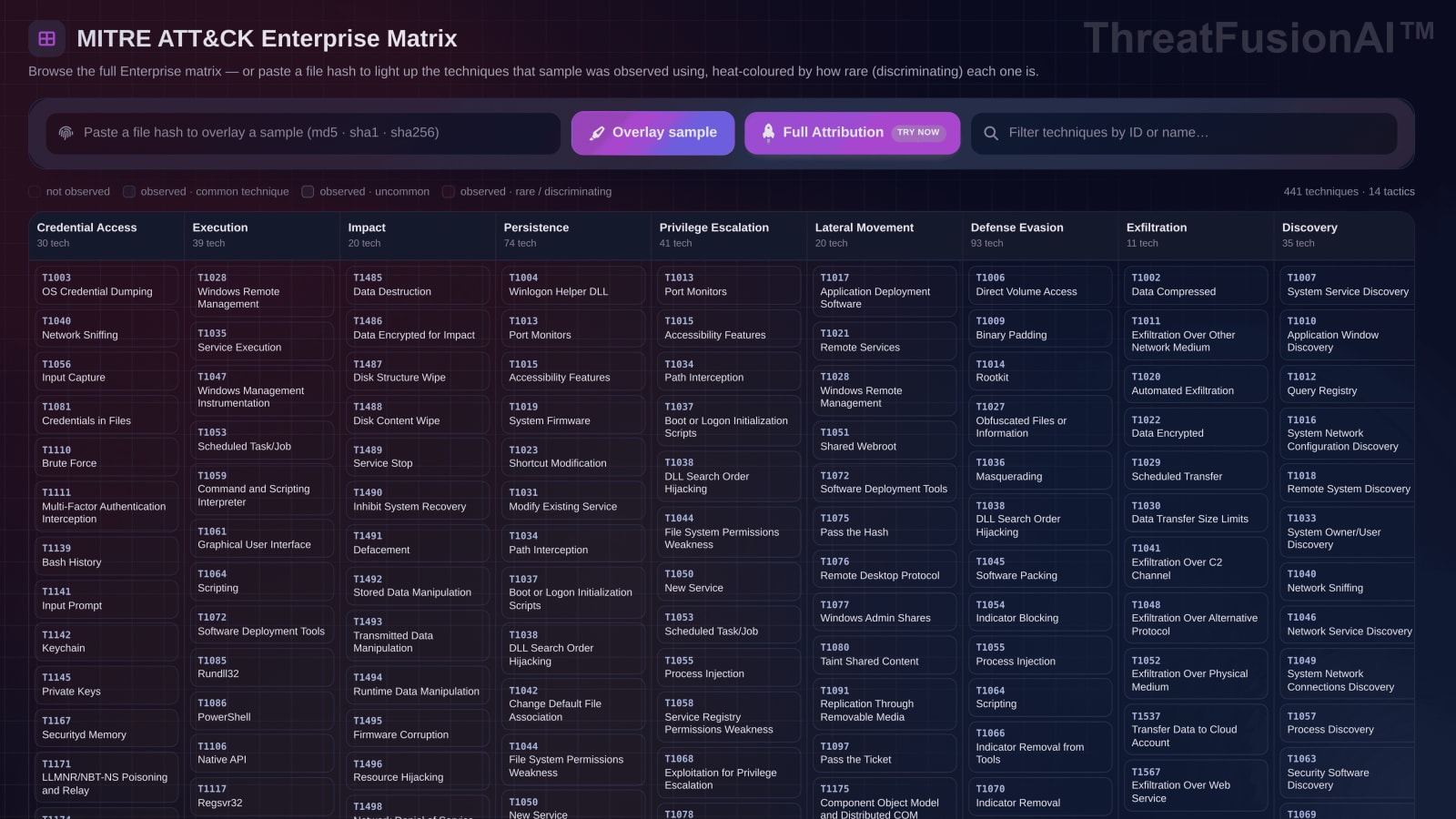
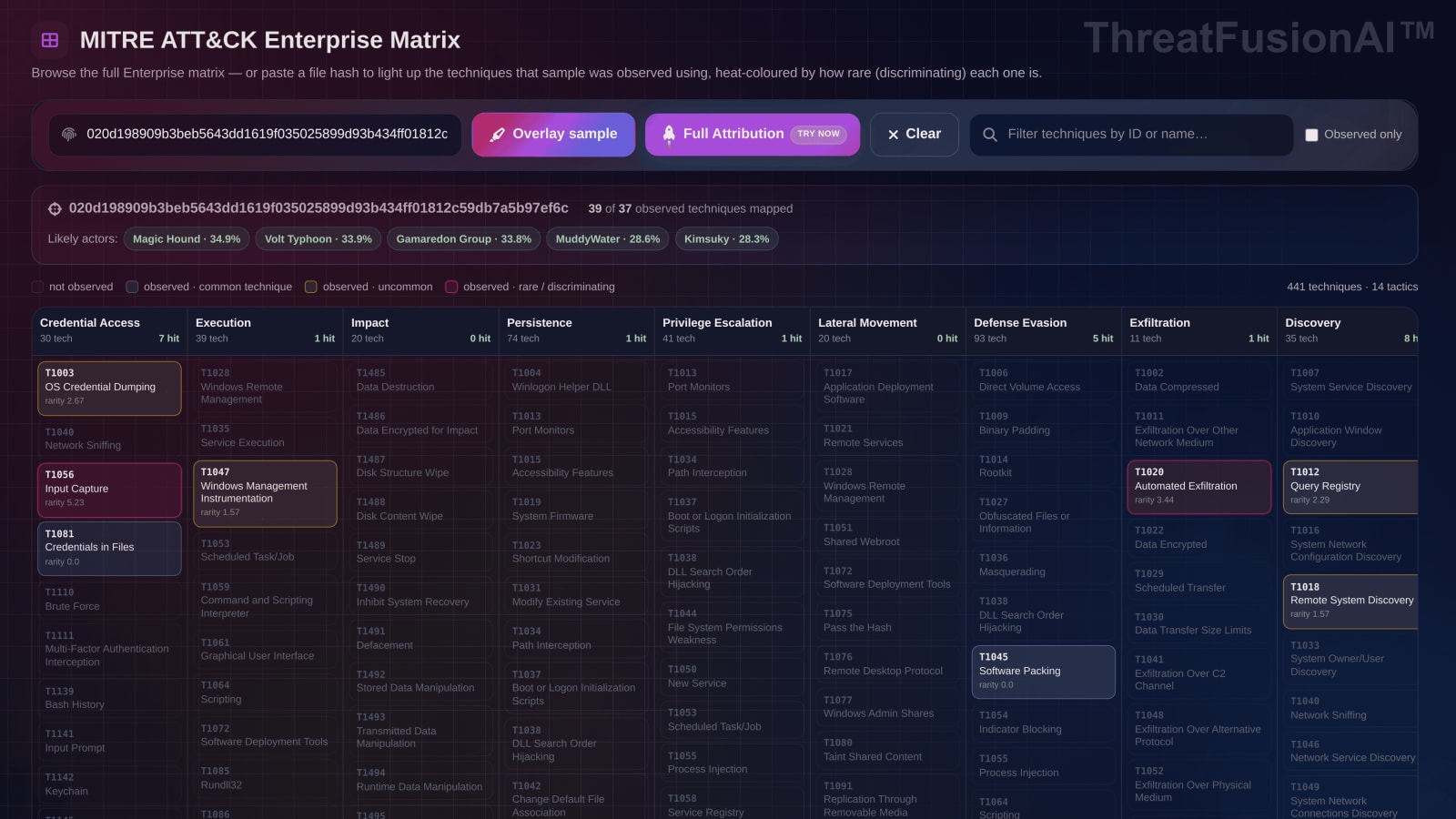
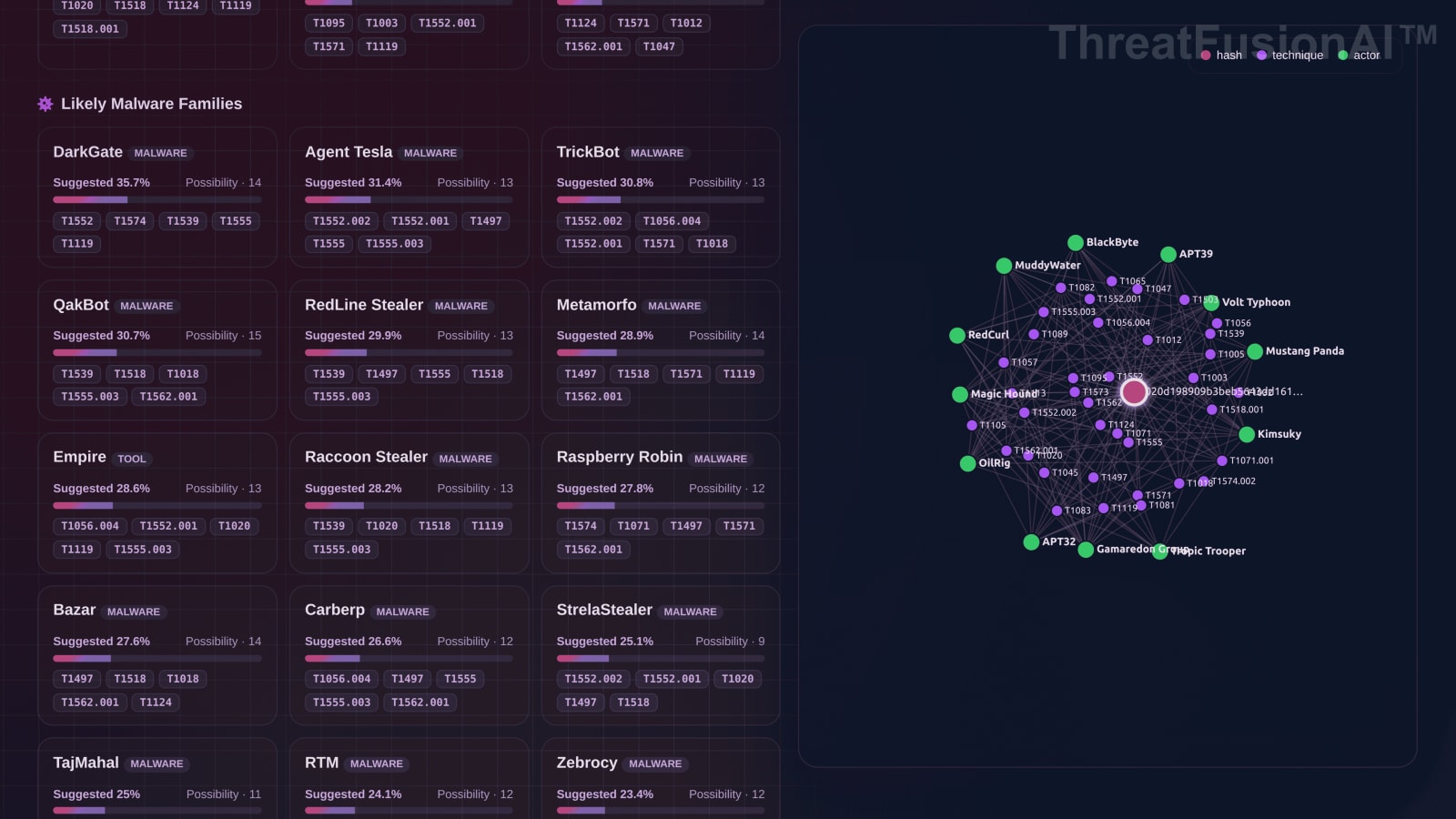
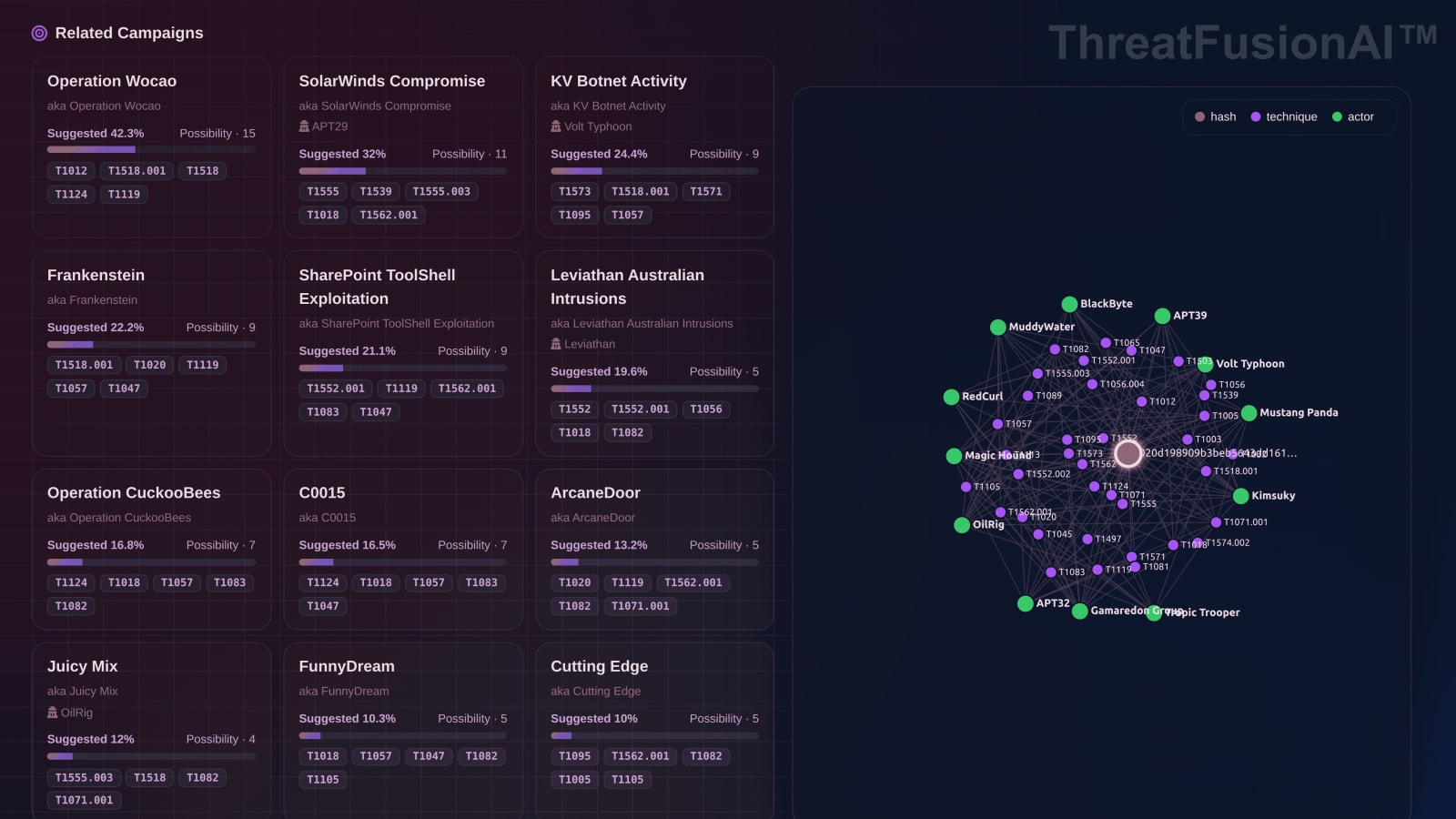
ThreatFusionAI helps analysts comprehend how a malware sample functions by integrating attacker behavior with the MITRE ATT&CK framework, Instead of seeing only a malicious verdict, analysts can examine which MITRE ATT&CK techniques were associated with the observed behavior.
View Enterprise ATT&CK techniques across the familiar ATT&CK matrix structure, Search and investigate techniques by ID or name and understand how they fit within attacker tactics.
Submit a malware hash and identify ATT&CK techniques associated with the sample's observed behavior, heat-coloured by how rare — and therefore how discriminating — each technique is.
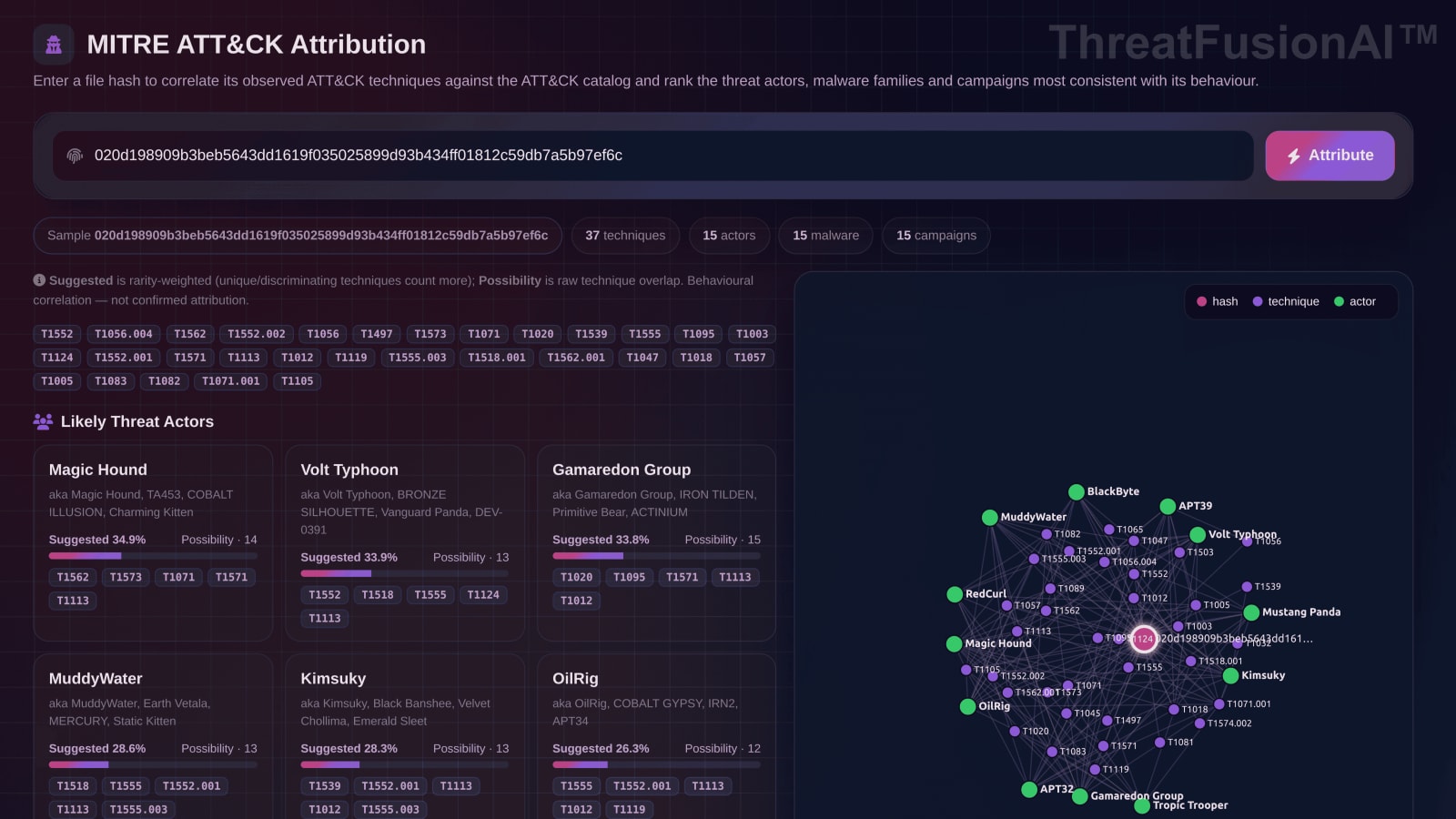
ThreatFusionAI compares observed techniques with documented activity from tracked threat groups. Rare or distinctive combinations can provide stronger investigative clues than techniques commonly used by many attackers.
Observed behaviour is compared against known malware and tools including DarkGate, Agent Tesla, TrickBot and QakBot, ranked by how much of the sample's behaviour each one explains.
Investigate known campaigns and their associated threat actors where supporting relationships exist — Operation Wocao, SolarWinds Compromise, KV Botnet Activity — each arriving with its attributed actor attached.
Security teams can use the MITRE security framework and ATT&CK knowledge base to describe attacker behavior consistently across investigations, ThreatFusionAI helps analysts connect malware activity with:
Threat intelligence teams, SOC analysts, incident responders, and security leadership can all communicate better as a result.
Ransomware investigations often involve much more than the encryption event itself. Attackers employ techniques across multiple lifecycle stages, including initial access, credential access, discovery, lateral movement, command and control, defence evasion, exfiltration and impact.
What the platform provides.ThreatFusionAI helps investigators compare observed malware behavior with these techniques and investigate related threat activity, Using ransomware MITRE ATT&CK mapping allows analysts to describe this behavior using standardized ATT&CK tactics and techniques.
Instead of waiting for another alert, threat hunting entails actively searching for attacker behavior, An indicator-driven threat hunting process is supported by ThreatFusionAI.
Start with:
and continue pivoting through connected intelligence.
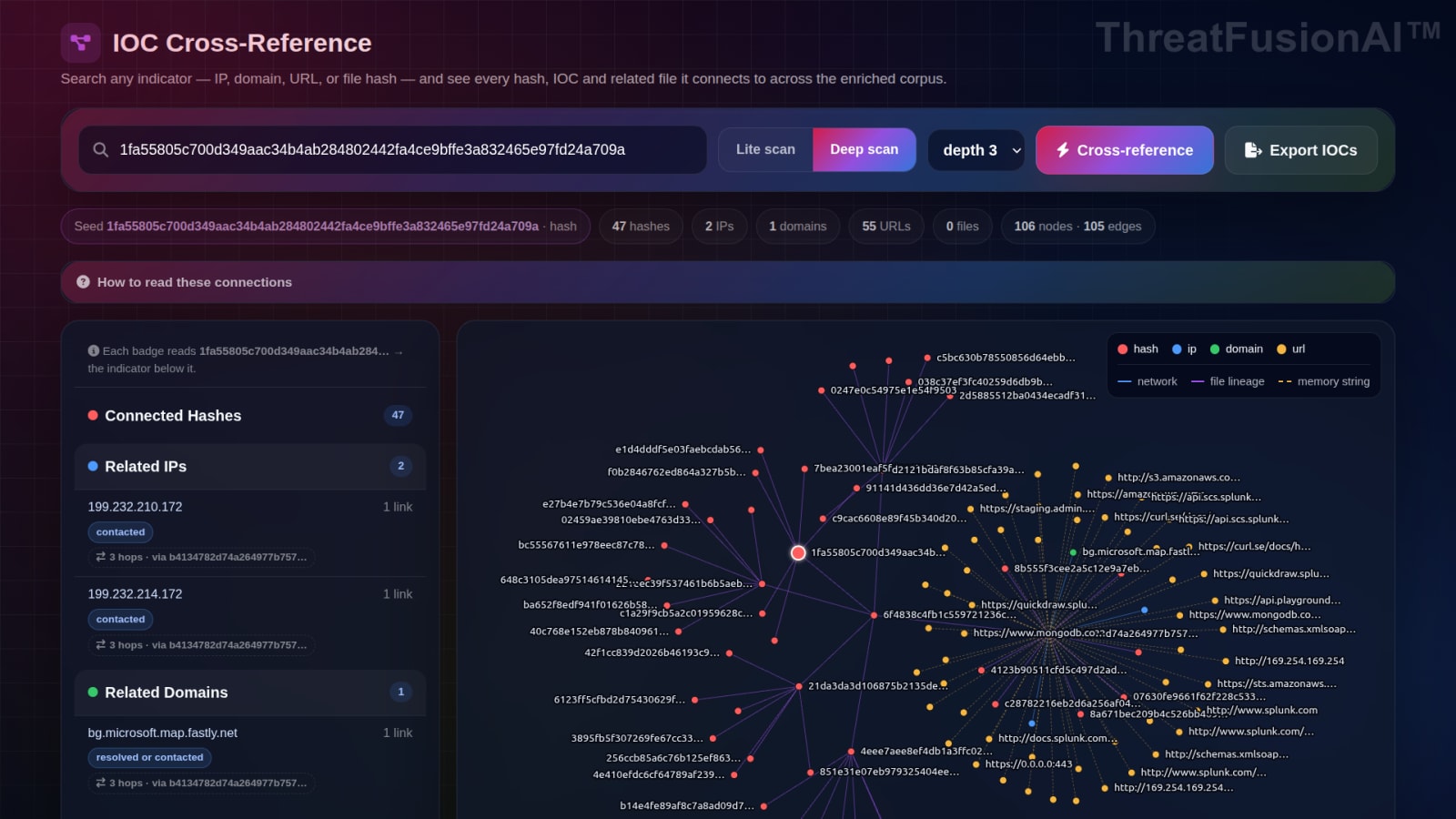
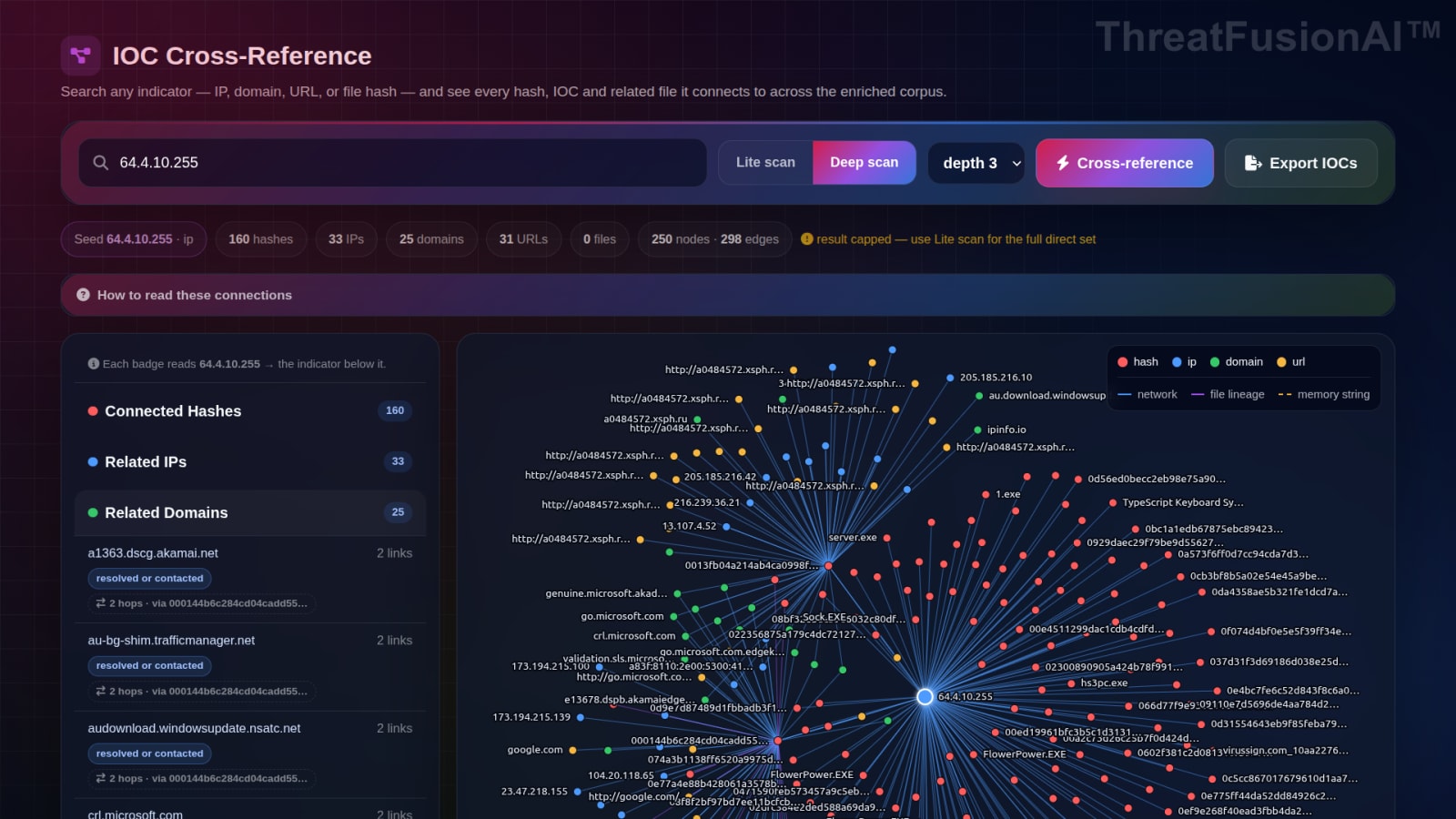
Submit an indicator and view its immediate connections, including related: Related Hashes, IP addresses, Domains and URLs. Relationships are presented visually to help analysts understand the immediate blast radius.
Increase the investigation depth to discover broader connections across the intelligence graph. Click a connected node to make it the new investigation center and continue following the trail. Export relevant IOCs for use in your existing security workflow.
ThreatFusionAI combines multiple forms of security intelligence rather than relying on a single feed. Information can include:
Public threat intelligence sources, folded into the wider investigation workflow rather than presented as a standalone list.
Malware and file reputation intelligence drawn from multiple detection engines.
Observed malware behaviour and the indicators extracted from detonation.
The public catalogue of attacker tactics and techniques, used as the common vocabulary across investigations.
Our own analysis at Craw Security, across the samples already processed by the platform.
The relationship map we build ourselves by extracting indicators from every sample and linking them back to the corpus.
For teams comparing the best threat intelligence feeds, the important question is not simply how many indicators a feed contains. The more useful question is: Can those indicators be connected with malware, behavior, infrastructure, and attacker activity? That correlation is where ThreatFusionAI focuses.
OSINT remains an important part of modern cybersecurity investigations. ThreatFusionAI incorporates open-source intelligence into a broader investigation workflow, making it useful for teams looking for an open source threat intelligence platform approach combined with malware analysis, IOC correlation, and ATT&CK mapping.
Indicators from breach investigations, external attack-surface monitoring, dark web threat intelligence, credential exposure investigations, and other security intelligence sources are regularly sent to security teams.
By comparing supported indications found through those workflows with available malware, infrastructure, IOC, and threat intelligence data, ThreatFusionAI can assist analysts in their investigation.
This means an indicator discovered through a dark-web investigation can become a starting point for broader technical analysis rather than remaining an isolated finding.
ThreatFusionAI should not be interpreted as claiming standalone dark-web monitoring where such monitoring is not explicitly provided by the platform.
Not part of the self-serve tiers. This is an analyst-led engagement scoped to your organisation, not a button in the search box. The plans above cover the indicator lookups; dark web coverage is arranged separately.
SIEMs generate thousands of alerts containing questionable IP addresses, domains, URLs and file hashes. ThreatFusionAI helps analysts enrich those indicators, so SOC teams can investigate alerts without manually opening multiple intelligence portals for every one.
SIEM and EDR detections hand you an IP, a hash, a domain or a URL. Those are four of the seven types we take. Nothing needs reformatting first.
Reputation, related malware and connected infrastructure all come back together, so the block-or-monitor call is made with the context already attached.
Every lookup on this page is also a token-authenticated REST call, so the same enrichment can run inside your SOAR playbook without an analyst in the loop.
The value of a latest IOC derives from context rather than recency alone. A newly observed IP address is worth far more once an analyst understands what surrounds it.
ThreatFusionAI focuses on converting individual indicators into connected intelligence that supports faster investigations.
The investigation looks different depending on what is being protected. These are the teams that get the most out of the platform.
Examine phishing infrastructure, malicious IP addresses, suspicious domains, malware, and threat actor activity directed at financial institutions.
In situations where reducing response time is crucial, expedite investigations into ransomware, malware, suspicious infrastructure, and IOCs.
Examine specific threats and contrast reported attacker activity with MITRE ATT&CK methodologies and recognized threat groups.
Investigate intelligence across multiple customers and integrate available capabilities into existing security workflows through the API.
Examine phishing infrastructure, malware, dubious domains, URLs, and other signs of fraud and credential-focused attacks.
Provide students, researchers, and security teams with an accessible platform for malware, IOC, and ATT&CK investigation.
One Threat Intel Platform. Multiple Investigation Workflows. Many security products answer only one question. ThreatFusionAI is designed to help analysts continue beyond the first verdict.
All from a single unified interface.
Submit a suspicious file hash, IP address, domain, URL, CVE, email or phone number and get the relevant security context from one interface.
Move from an individual IOC to connected malware, domains, infrastructure and related indicators, rather than treating each one separately.
Map observed malware activity to MITRE ATT&CK techniques and compare that behaviour with tracked threat actors, malware families and campaigns.
Craw Security supplies internal analysis and security research; MITRE ATT&CK the standardised attacker tactics and techniques; multi-engine antivirus the malware and file reputation intelligence; sandbox telemetry the observed behaviour and extracted indicators; and OSINT feeds the open-source intelligence that enriches an investigation.
ThreatFusionAI brings these investigation functions into a single intelligence workflow.For organizations searching for the best threat intelligence platform for their environment, the right choice ultimately depends on investigation volume, required intelligence sources, integrations, analyst workflow, and operational requirements.
When security teams evaluate top threat intelligence platforms, useful capabilities to consider include:
From an 80-minute investigation to one connected workflow. Here is where the hours go today, and where they go with ThreatFusionAI.
Reduce the manual searching across multiple security tools that consumes most of an investigation.
Identify the relationships between suspicious files, IP addresses, domains, URLs, malware and attacker activity.
Pivot from an indicator into the broader infrastructure and malware relationships around it.
Enrich raw SIEM and EDR indicators before the response decision is made.
Connect malware activity with MITRE ATT&CK tactics and techniques so every investigation is described the same way.
Use behavioural correlation as an investigative lead when malware behaviour overlaps with known threat groups.
ThreatFusionAI offers a freemium model, allowing security professionals, researchers and students to investigate threats without a credit card. For organizations requiring greater search volume, API usage, or enterprise capabilities, higher tiers can be requested.
In order to help analysts comprehend cyber dangers, a cyber threat intelligence platform gathers, arranges, correlates, and displays security intelligence. IOC investigation, malware analysis, relationship mapping, MITRE ATT&CK behavior, and threat actor correlation are the main areas of interest for ThreatFusionAI.
Security teams can look at suspicious indicators such as file hashes, IP addresses, domains, URLs, and vulnerabilities with the aid of a threat intel platform. This data is used by analysts for threat hunting, malware research, incident response, SOC investigations, and security monitoring.
ThreatFusionAI incorporates OSINT and public security intelligence into its analysis workflow, but the ThreatFusionAI platform itself should not be described as open-source software unless Craw Security separately releases its source code. It can, however, support teams looking to combine open source threat intelligence platform data with malware, IOC, and ATT&CK investigations.
ThreatFusionAI focuses on what happens after an IOC lookup. Analysts can investigate connected infrastructure, malware relationships, extracted indicators, MITRE ATT&CK behavior, and possible threat actor similarities instead of receiving only an isolated reputation result.
There is no single best threat intelligence platform for every security organization. Requirements differ between SOC teams, MSSPs, researchers, incident responders, and enterprises. ThreatFusionAI is designed for teams that need IOC correlation, malware intelligence, relationship mapping, ATT&CK analysis, and threat hunting from a unified interface.
ThreatFusionAI currently supports seven primary lookup types:
Available intelligence depends on the indicator type.
Yes, supported domain and URL intelligence can help analysts investigate suspicious websites and links during phishing, malware, and security investigations. The results should be considered security intelligence for investigation rather than a substitute for organizational security controls.
Available antivirus verdicts, observed activity, extracted IOCs, associated infrastructure, MITRE ATT&CK methods, and potential threat actor or malware-family correlations can all be included in a file analysis.
A popular knowledge base that describes attacker strategies and tactics based on actual adversary activity is the MITRE ATT&CK framework. It is used by security teams to categorize and share the methods used by attackers.
MITRE ATT&CK techniques and tactics explain how adversaries accomplish their goals during cyberattacks. ThreatFusionAI can assist analysts comprehend how a sample functions by linking observed malware activity with pertinent methodologies.
Adversarial tactics, including execution, persistence, privilege escalation, defensive evasion, credential access, discovery, lateral movement, command and control, exfiltration, and impact, are arranged according to tactical objectives in the ATT&CK matrix.
ThreatFusionAI can help analysts examine malware behavior and map available observations to ATT&CK techniques, which can support ransomware MITRE ATT&CK investigations and behavioral analysis.
Indicators of compromise in cyber security are observable values or evidence that may indicate malicious activity. Malicious hashes, IP addresses, domains, URLs, registry modifications, filenames, and network artifacts are typical examples.
Atomic indicators of compromise are individual values such as IP addresses, domains, URLs, and file hashes that can usually be searched or matched directly within security systems.
Copy a suspicious indicator from your SIEM alert and search it in ThreatFusionAI. You can then review available reputation intelligence, malware relationships, associated infrastructure, and other contextual information before deciding how to respond.
ThreatFusionAI can help investigate supported indicators obtained during dark web threat intelligence or external exposure investigations. Dedicated dark-web monitoring should only be represented as a ThreatFusionAI feature if that capability is specifically available in the platform.
The best threat intelligence feeds depend on the organization's requirements. Useful feeds should provide relevant, timely, contextualized, and actionable information rather than simply large volumes of indicators. ThreatFusionAI combines multiple intelligence sources with its own relationship and investigation workflow.
Yes. Supported browser-based investigation capabilities can also be integrated with security workflows through the ThreatFusionAI API, subject to the applicable account and access level.
Practical research covering emerging malware, threat intelligence, malware analysis, IOC investigations, MITRE ATT&CK, ransomware behaviour, threat hunting and security operations.
ThreatFusionAI brings threat intelligence, malware analysis, IOC correlation, MITRE ATT&CK mapping, threat hunting, and security intelligence together in one investigation workflow.
Start with one suspicious indicator and discover what it is really connected to.
AI assistant — can make mistakes. Verify important results.